Totus Tuus - To Jesus through Mary.

To impel the beauty of the new evangelization – this is the charism of the Heralds of the Gospel; Its founder, Monsignor João Dias explains."The Heralds of the Gospel is a private association of faithful with a very special charism based essentially on three points: the Eucharist, Mary and the Pope."

The Heralds of the Gospel are an International Association of the Faithful of Pontifical Right, the first to be established by the Holy See in the third millennium, during a ceremony which occurred during the feast of the Chair of St. Peter (February 22) in 2001.

The Heralds of the Gospel strive to be instruments of holiness in the Church by encouraging close unity between faith and life, and working to evangelize particularly through art and culture. Their apostolate, which differs depending upon the environments in which they work, gives pride of place to parish animation, evangelizing families, providing catechetical and cultural formation to young people, and disseminating religious Iiterature.


Wednesday, 9 March 2011

Lent:Why the Christian Must Deny Himself [Part 2]


Lent: Why the Christian Must Deny Himself [cont'd]
Brother Austin G. Murphy, O.S.B.

The full article may be found on the website of Ignatius Insight http://www.ignatiusinsight.com/features2005/murphy_denyhimself1_feb05.asp

Obstacles To Grace

So, it is not wrong, in itself, to seek tasty, enjoyable food: but still a person should not do so. For when a person seeks the enjoyment of eating, his action is tainted with inclinations to sloth, complacency, and self-love. That is, his motives are mixed. For when he seeks the joys of food, selfish inclinations are at work in his heart along with whatever good motives there might be. Now, if a person only looks at the external act of eating or the objective value of enjoying food, he will not see this. But, if he honestly looks into the heart, he will see that sloth, complacency, and self-love are present in the desire for the joys of eating. Having such mixed motives is simply part of our imperfect condition in this world.

These selfish inclinations in a person's heart, which are present when he seeks the enjoyment of eating, are the sort of things that hinder a person's growth in holiness and virtue. To grow in holiness and virtue every person needs God's help–we know that a person cannot do it on his own. As Christ says, "Apart from me you can do nothing." Hence, the help of God's grace is needed to grow in virtue and to live a life of continual conversion. Yet the presence of these inclinations to sloth, complacency, and self-love get in the way of a person's reception of God's grace. They are obstacles to receiving more grace.

Therefore, the Christian, who is dedicated to conversion, must remove these obstacles from his heart, so that he may receive more grace and become a better follower of Christ. A person should not expect God to force his grace on him without his consent. As we know, God chooses to work with a person's cooperation. And, so, he is obliged to work with God to remove these inclinations from his heart as much as possible.

This is done by fasting. For fasting, by checking a person's desires for what is not necessary, teaches him to seek what is sufficient when he eats. When he fasts, he does not seek the enjoyment of food, but is simply seeking what he needs to eat and drink. And since he is no longer pursuing the joys of food, the self-centered inclinations that accompany this pursuit are not allowed a chance to spring up in his heart. A person gives up things he enjoys because in so doing he denies inclinations such as sloth, complacency, and self-love a chance to be active in his heart.

Purifying The Heart

This is why it is better to fast. Fasting removes these obstacles so that being more receptive to God's grace, a person will grow in holiness and virtue. The self-centered inclinations that accompany pleasure-seeking are not directed towards God–therefore, they do not lead the heart to God but away from him. Their presence in the heart creates a divided heart–a heart, which does not completely look to God for its needs. As St. Augustine teaches, a divided heart is an impure heart.

Purifying the heart, then, will involve denying oneself the pursuits of pleasures in things like food and drink. For thus a person protects his heart from the self-centered inclinations that are bound to coexist with these pursuits.

This provides one answer to the question, "Why must we fast?" (and, by extension, to the question, "Why should one practice self-denial?"). Since, by fasting, a person no longer seeks after the joys of food and drink, the heart is set free to focus more completely on God. By turning away from his concerns for the pleasures of eating, he can turn more wholeheartedly to God. And this, we know is what continual conversion is all about.

By fasting, then, a person turns to God more intently. This is reflected in God's words spoken through the Prophet Joel: "Return to me with all your heart, with fasting, with weeping, and with mourning." Naturally, a person is reluctant to give up through fasting things he enjoys–but by doing so he turns his attention to God and waits for him. He places his trust in him that he will give him the joy he needs–joys "greater than when grain and wine abound." But he has to trust and be willing to persevere through the dry times that will accompany fasting. If he puts his hope in God, however, the Scriptures assure him that he will not be disappointed.

For the sake of his ongoing conversion, then, the Christian must fast. But we might add another, better reason for fasting. Not only does fasting benefit a person's own individual spiritual progress, it also benefits his neighbor.

It is commonly pointed out that fasting can help others by allowing those who fast to increase their almsgiving with the money saved from eating less. But the benefit referred to here is of a different sort. It is due to our being connected with each other through prayer, so that a person's offering of prayer can help others. Now, prayers for others are more effective the more united the person praying is to Christ, since Christ is the source of the benefits gained through prayer. So the more converted a person becomes to the Lord, the more effective his prayers for others: "The prayer of a righteous man has great power in its effects." And since fasting aids a person's continual conversion, it strengthens his prayers so that they benefit others more. In this way, he can help his neighbor through fasting.

Moreover, this service to his neighbor through fasting is an imitation of Christ. He offered himself on the Cross for others. A person too, in union with Christ, offers himself through the sacrifice of fasting. In fasting, he has the opportunity to join Christ in offering himself for the sake of others. Thus, even if a person's heart were pure and always free from selfish inclinations–as was Christ's–he should still fast–as did Christ. Through Christ he has the chance of helping others through voluntary acts of self-denial. Christian love is, indeed, eager for such chances to serve others.

So, in a very real way that is clearly visible to the eyes of faith, the Christian must fast out of love of neighbor. He is commanded by Jesus to live in his love. This love is the love that compels a person "to lay down his life for his friends." That is, it is the love that compels him to sacrifice his own preferences and desires on behalf of others. And this is what each person is invited to do through fasting– to give up things he enjoys for the benefit of others. And, as we are told, "there is no greater love than this."

There are good reasons then, why a person must practice fasting and develop disciplined eating habits. Fasting and, by extension, self-denial are important for a person's continual conversion as well as for others who need our prayers. So, the Christian should regularly ask himself, "What do I really need? What can I do without?" and consider the advantages of denying himself even things that are not necessarily bad.

A better understanding of the virtue of denying oneself would undoubtedly benefit our society, where one is taught only how to say, "yes" to what one wants and desires. The practice of self-denial provides a humble yet profound way of giving oneself to God and others out of love, thus breaking the tendency to self-absorption. For, as we have said, self-denial is necessary for helping bring about ongoing conversion, which is sought out of love of God: and one restrains oneself and sacrifices one's desires out of love of neighbor. Love, then–real liberating, sacrificial love–is behind voluntary self-denial.

For part one, go to: http://heraldsgospelsinengland.blogspot.com/2011/03/lent-why-christian-must-deny-himself.html

Brother Austin G. Murphy, O.S.B., is a member of St. Procopius Abbey in Lisle, Ill. He was born in Huntington, L.I., and grew up in Suffern, N.Y. In December of 1995 he received his B.A. in Economics from the University of Chicago. While in formation and preparation to take solemn vows at St. Procopius Abbey, he teaches high school mathematics at the abbey’s high school, Benet Academy.

Lent: Why the Christian Must Deny Himself [Part 1]


Lent: Why the Christian Must Deny Himself
Brother Austin G. Murphy, O.S.B.

This article may be found on the website of Ignatius Insight http://www.ignatiusinsight.com/features2005/murphy_denyhimself1_feb05.asp

We still ask ourselves as Ash Wednesday approaches, "What am I doing for Lent? What am I giving up for Lent?" We can be grateful that the customs of giving up something for Lent and abstaining from meat on Fridays during Lent have survived in our secular society. But, unfortunately, it is doubtful that many practice them with understanding. Many perform them in good faith and with a vague sense of their value, and this is commendable. But if these acts of self-denial were better understood, they could be practiced with greater profit. Otherwise, they run the risk of falling out of use.

A greater understanding of the practice of self-denial would naturally benefit those who customarily exercise it during Lent. Better comprehension of self-denial would also positively affect the way Christians live throughout the year. The importance of self-denial can be seen if we look specifically at fasting and use it as an example of self-denial in general. Indeed, fasting, for those who can practice it, is a crucial part of voluntary self-denial.

But since we live in a consumerist society, where self-indulgence rather than self-denial is the rule, any suggestion to fast will sound strange to many ears. It is bound to arouse the questions: Why is fasting important? Why must a Christian practice it? Using these questions as a framework, we can construct one explanation, among many possible ones, of the importance of self-denial.

To answer the question "Why must the Christian fast?" we should first note that fasting, in itself, is neither good nor bad, but is morally neutral. But fasting is good insofar as it achieves a good end. Its value lies in it being an effective means for attaining greater virtue. And because it is a means for gaining virtue– and every Christian ought to be striving to grow in virtue–there is good reason to fast.

Some people point out that fasting is not the most important thing and, therefore, they do not need to worry about it. Such reasoning displays a misunderstanding of our situation. But, since the excuse is common enough, some comments to refute it are worthwhile.

Doing Small Things Well

First, while it is true that fasting is not the most important thing in the world, this does not make fasting irrelevant or unimportant. There are, certainly, more urgent things to abstain from than food or drink, such as maliciousness, backbiting, grumbling, etc. But a person is mistaken to conclude that he therefore does not need to fast. He should not believe that he can ignore fasting and instead abstain in more important matters. Rather, fasting and avoiding those other vices go hand in hand. Fasting must accompany efforts to abstain in greater matters. For one thing, fasting teaches a person how to abstain in the first place.

Moreover, it is presumptuous for a person to try to practice the greater virtues without first paying attention to the smaller ones. As Our Lord says, "He who is faithful in a very little is faithful also in much" and so can be trusted with greater things. Therefore, if a person wants to be able to abstain in greater matters he must not neglect to abstain in smaller matters, such as through fasting.

Finally, there is a subtle form of pride present in the person who says that because something is not very important, he does not need to do it. Whoever makes such a claim implies that he does only important things. But the average person is rarely called to do very important things. Accordingly, each person is more likely to be judged on how he did the little, everyday things. Even when, rarely, a person is called to do a great work, how often does he fall short? All the more reason, then, for a person to make sure that he at least does the small things well. Furthermore, if he truly loves the Lord, he will gladly do anything–big or small–for him. So, in the end, saying that fasting is not the most important thing is not a good excuse for avoiding it.

What, then, is the reason for fasting? To answer this let us first clarify what fasting entails. It involves more than the occasional fast, such as on Good Friday. To be effective, fasting requires disciplined eating habits all the time. There are certainly days when a person should make a greater effort at abstaining from food and drink. These are what we usually consider days of fasting and they must be practiced regularly. But, still, there are never days when a person is allowed to abandon all restraint. A person must always practice some restraint over his appetites or those periodic days of fasting arc valueless. Always keeping a check on his desires, a person develops good habits, which foster constancy in his interior life. So, in addition to practicing days of fasting on a regular basis, a person should continuously restrain his desires, such as those that incline him to eat too much, to be too concerned with what he eats, or to eat too often.

We might, then speak of the discipline of fasting in order to avoid the impression that fasting is sporadic. The operative principle behind the discipline of fasting is simple: to limit yourself to only what is necessary for your physical and psychological health–no more, no less. St. Augustine puts it concisely when he teaches: "As far as your health allows, keep your bodily appetites in check by fasting and abstinence from food and drink." So, fasting is meant only to keep a person's unnecessary wants in check. A person is not– nor is he permitted–to deny himself what is necessary for his health. The discipline of fasting instead asks a person to check his desires for what is superfluous and not necessary.

Realizing True Well-being

Consequently, fasting should not threaten a person's health. And there is no foundation for believing that fasting is somehow motivated by anti-body sentiments. Fasting actually does good for the body by helping it realize its well-being. The body needs to be in conformity with the spirit and this requires such disciplines as fasting. In this way, the body is like a child. Children would never realize their true well-being if their parents never told them "no," but gave in to every one of their desires. In the same way, if a person never says "no" to his bodily desires, his body will never realize its true well-being. That is, the body needs such discipline to be brought into conformity with the spirit. For otherwise, it cannot share in the spiritual blessings of Christ.

This makes perfect sense when we consider that the human person is not just a soul, but is matter as well. A person’s body, too, is to be renewed in Christ. Fasting is one way that a person brings about a harmony between body and soul, so that being made whole he can be one with Christ.

The Christian belief that the body is intimately united to the soul should also make a person suspicious of the opinion that fasting is merely external. External acts stem from the desires of the heart within, as Our Lord says in the Gospel. So, a person's external acts are linked to his interior desires. The external act of abstaining from food and drink, therefore, clearly affects a person internally. It does not permit his desires within to reach fulfillment. Thus fasting has the ability to keep interior desires in check, which is important for improving a person's interior life.

It is true, of course, that a person should be more vigilant over his interior life than over his external actions. He must be attentive to interior motives, desires, intentions, to make sure that his fasting is affecting his interior life as it ought–and not giving rise to pride, anger, or impatience.

In fact, only by considering the interior self, and how fasting can affect it, does one see the high value of fasting. If someone looks only at the external act of eating, and does not consider the underlying internal desires of the heart, then the value of fasting cannot be seen. For, clearly, there is nothing wrong with the very act of eating. Nor do the enjoyments of food and the pleasures of eating, as such, harm a person. The joys and comforts of eating are good. Like all created goods, they testify to the goodness of God, who made them. Therefore, the enjoyment of eating and drinking manifests the goodness of God. A person ought to see God's goodness in the joys of these things, and give God thanks for them. The enjoyment of food can then actually help lift the mind and heart to God.

But by lifting a person's gaze to God, created goods point beyond themselves, to greater joys. Consequently, he who truly enjoys God's goodness in created things, such as food and drink, will not remain attached to them. Rather, he will go beyond them, readily giving them up, in order to enjoy the higher things, which St. Paul says we must seek.

Seek What Is Better

This might lead some to ask: If the enjoyment of eating does me no harm, and can in fact manifest God's goodness, why sacrifice this joy by fasting? That is, why check my unnecessary desires for what is enjoyable? After all, there is nothing wrong with enjoying food. Why, then, if I enjoy having a snack, or eating fine foods, sacrifice these things? Again, they are not bad or sinful.

The answer is: Because it is better. Having a tasty meal prepared just to my liking is good, but it is better to sacrifice such things. Showing why it is better to fast than to neglect fasting will provide the reason why a Christian is expected to fast.

A Christian must be seeking what is better, and not merely trying to avoid what is bad. This is the only way to live a life of continual conversion, to which we are committed by baptism. The Christian must face decisions with the question: "What is the better thing for me to do?" He must not, when he has a decision to make, approach what he is inclined to do with the justification: "Well, there is nothing wrong with doing it." If that is his approach, then he is not genuinely seeking improvement in his life. Spiritual progress becomes impossible.

Ongoing conversion, to which, again, the Christian must be dedicated, involves going from good to better. This conversion is unreachable for him who in his life refuses to give up the lesser goods in order to attain greater goods. Due to fallen human nature, every person is prone to be complacent. Each of us is reluctant to change his ways. But clearly, if a person has not yet reached perfection, there are certainly greater goods for him to realize. Fasting, in many ways, is simply the choice to give up lesser goods for greater ones, to abstain from the joys of food and drink in order to attain greater joys from God. It seeks for more. If a person ever stops seeking for more, then he has stopped seeking God.

Why is it better to fast than not to fast? Again, we said that the enjoyment of food and drink is good. Enjoying food is not the problem. Fasting does not tell a person not to enjoy eating–I think this is impossible–as much as it says not to seek the enjoyment of eating. A person may take the joys of food as they come, and be grateful for them: but he should not pursue such joys.

True, there are legitimate occasions, such as when entertaining guests, where especially enjoyable foods are procured. But this is done for the sake of hospitality and for lifting up the heart and mind to God in thanksgiving. The joys of food and drink are not sought, consequently, for their own sake but for God's glory. Thus, the person is not really seeking the joys of eating and drinking, as such: he uses them only to pass beyond them to God. Hence, he who uses the joys of eating and drinking rightly will readily give them up. Because fasting is better than not fasting, he will deny himself these joys regularly. "Looking to the reward," moreover, he will not often make the excuse that hospitality, or the "need" to celebrate, requires that he allow himself enjoyable foods. In truth, it is more often the case that self-denial and restraint are called for.

See Part 2:
http://heraldsgospelsinengland.blogspot.com/2011/03/lent-why-christian-must-deny-himself_09.html

Brother Austin G. Murphy, O.S.B., is a member of St. Procopius Abbey in Lisle, Ill. He was born in Huntington, L.I., and grew up in Suffern, N.Y. In December of 1995 he received his B.A. in Economics from the University of Chicago. While in formation and preparation to take solemn vows at St. Procopius Abbey, he teaches high school mathematics at the abbey’s high school, Benet Academy.

Pope Benedict XVI's Message for Lent 2011


Pope Benedict's Message this year has as its title a passage with a theme from Colossians: "You were buried with him in baptism, in which you were also raised with him." (cf. Col 2: 12) The full text is given below:

Dear Brothers and Sisters,

The Lenten period, which leads us to the celebration of Holy Easter, is for the Church a most valuable and important liturgical time, in view of which I am pleased to offer a specific word in order that it may be lived with due diligence. As she awaits the definitive encounter with her Spouse in the eternal Easter, the Church community, assiduous in prayer and charitable works, intensifies her journey in purifying the spirit, so as to draw more abundantly from the Mystery of Redemption the new life in Christ the Lord (cf. Preface I of Lent).

1. This very life was already bestowed upon us on the day of our Baptism, when we "become sharers in Christ's death and Resurrection", and there began for us "the joyful and exulting adventure of his disciples" (Homily on the Feast of the Baptism of the Lord, 10 January, 2010). In his Letters, St. Paul repeatedly insists on the singular communion with the Son of God that this washing brings about. The fact that, in most cases, Baptism is received in infancy highlights how it is a gift of God: no one earns eternal life through their own efforts. The mercy of God, which cancels sin and, at the same time, allows us to experience in our lives "the mind of Christ Jesus" (Phil 2: 5), is given to men and women freely.The Apostle to the Gentiles, in the Letter to the Philippians, expresses the meaning of the transformation that takes place through participation in the death and resurrection of Christ, pointing to its goal: that "I may come to know him and the power of his resurrection, and partake of his sufferings by being molded to the pattern of his death, striving towards the goal of resurrection from the dead" (Phil 3: 10-11). Hence, Baptism is not a rite from the past, but the encounter with Christ, which informs the entire existence of the baptized, imparting divine life and calling for sincere conversion; initiated and supported by Grace, it permits the baptized to reach the adult stature of Christ.

A particular connection binds Baptism to Lent as the favorable time to experience this saving Grace. The Fathers of the Second Vatican Council exhorted all of the Church's Pastors to make greater use "of the baptismal features proper to the Lenten liturgy" (Constitution on the Sacred Liturgy Sacrosanctum concilium, n. 109). In fact, the Church has always associated the Easter Vigil with the celebration of Baptism: this Sacrament realizes the great mystery in which man dies to sin, is made a sharer in the new life of the Risen Christ and receives the same Spirit of God who raised Jesus from the dead (cf. Rm 8: 11). This free gift must always be rekindled in each one of us, and Lent offers us a path like that of the catechumenate, which, for the Christians of the early Church, just as for catechumens today, is an irreplaceable school of faith and Christian life. Truly, they live their Baptism as an act that shapes their entire existence.

2. In order to undertake more seriously our journey towards Easter and prepare ourselves to celebrate the Resurrection of the Lord - the most joyous and solemn feast of the entire liturgical year - what could be more appropriate than allowing ourselves to be guided by the Word of God? For this reason, the Church, in the Gospel texts of the Sundays of Lent, leads us to a particularly intense encounter with the Lord, calling us to retrace the steps of Christian initiation: for catechumens, in preparation for receiving the Sacrament of rebirth; for the baptized, in light of the new and decisive steps to be taken in the sequela Christi and a fuller giving of oneself to him.

The First Sunday of the Lenten journey reveals our condition as human beings here on earth. The victorious battle against temptation, the starting point of Jesus' mission, is an invitation to become aware of our own fragility in order to accept the Grace that frees from sin and infuses new strength in Christ - the way, the truth and the life (cf. Ordo Initiationis Christianae Adultorum, n. 25). It is a powerful
reminder that Christian faith implies, following the example of Jesus and in union with him, a battle "against the ruling forces who are masters of the darkness in this world" (Eph 6: 12), in which the devil is at work and never tires - even today - of tempting whoever wishes to draw close to the Lord: Christ emerges victorious to open also our hearts to hope and guide us in overcoming the seductions of evil.

The Gospel of the Transfiguration of the Lord puts before our eyes the glory of Christ, which anticipates the resurrection and announces the divinization of man. The Christian community becomes aware that Jesus leads it, like the Apostles Peter, James and John "up a high mountain by themselves" (Mt 17: 1), to receive once again in Christ, as sons and daughters in the Son, the gift of the Grace of God: "This is my Son, the Beloved; he enjoys my favor. Listen to him" (Mt17: 5). It is the invitation to take a distance from the noisiness of everyday life in order to immerse oneself in God's presence. He desires to hand down to us, each day, a Word that penetrates the depths of our spirit, where we discern good from evil (cf. Heb 4:12), reinforcing our will to follow the Lord.

The question that Jesus puts to the Samaritan woman: "Give me a drink" (Jn 4: 7), is presented to us in the liturgy of the third Sunday; it expresses the passion of God for every man and woman, and wishes to awaken in our hearts the desire for the gift of "a spring of water within, welling up for eternal life" (Jn 4: 14): this is the gift of the Holy Spirit, who transforms Christians into "true worshipers," capable of praying to the Father "in spirit and truth" (Jn 4: 23). Only this water can extinguish our thirst for goodness, truth and beauty! Only this water, given to us by the Son, can irrigate the deserts of our restless and unsatisfied soul, until it "finds rest in God", as per the famous words of St. Augustine.

The Sunday of the man born blind presents Christ as the light of the world. The Gospel confronts each one of us with the question: "Do you believe in the Son of man?" "Lord, I believe!" (Jn 9: 35. 38), the man born blind joyfully exclaims, giving voice to all believers. The miracle of this healing is a sign that Christ wants not only to give us sight, but also open our interior vision, so that our faith may become ever deeper and we may recognize him as our only Savior. He illuminates all that is dark in life and leads men and women to live as "children of the light".

On the fifth Sunday, when the resurrection of Lazarus is proclaimed, we are faced with the ultimate mystery of our existence: "I am the resurrection and the life... Do you believe this?" (Jn11: 25-26). For the Christian community, it is the moment to place with sincerity - together with Martha - all of our hopes in Jesus of Nazareth: "Yes, Lord, I believe that you are the Christ, the Son of God, the one who was to come into this world" (Jn 11: 27). Communion with Christ in this life prepares us to overcome the barrier of death, so that we may live eternally with him. Faith in the resurrection of the dead and hope in eternal life open our eyes to the ultimate meaning of our existence: God created men and women for resurrection and life, and this truth gives an authentic and definitive meaning to human history, to the personal and social lives of men and women, to culture, politics and the economy. Without the light of faith, the entire universe finishes shut within a tomb devoid of any future, any hope.

The Lenten journey finds its fulfillment in the Paschal Triduum, especially in the Great Vigil of the Holy Night: renewing our baptismal promises, we reaffirm that Christ is the Lord of our life, that life which God bestowed upon us when we were reborn of "water and Holy Spirit", and we profess again our firm commitment to respond to the action of the Grace in order to be his disciples.

3. By immersing ourselves into the death and resurrection of Christ through the Sacrament of Baptism, we are moved to free our hearts every day from the burden of material things, from a self-centered relationship with the "world" that impoverishes us and prevents us from being available and open to God and our neighbor. In Christ, God revealed himself as Love (cf. 1Jn 4: 7-10). The Cross of Christ, the "word of the Cross", manifests God's saving power (cf. 1Cor 1: 18), that is given to raise men and women anew and bring them salvation: it is love in its most extreme form (cf. Encyclical Deus caritas est, n. 12). Through the traditional practices of fasting, almsgiving and prayer, which are an expression of our commitment to conversion, Lent teaches us how to live the love of Christ in an ever more radical way. Fasting, which can have various motivations, takes on a profoundly religious significance for the Christian: by rendering our table poorer, we learn to overcome selfishness in order to live in the logic of gift and love; by bearing some form of deprivation - and not just what is in excess - we learn to look away from our "ego", to discover Someone close to us and to recognize God in the face of so many brothers and sisters. For Christians, fasting, far from being depressing, opens us ever more to God and to the needs of others, thus allowing love of God to become also love of our neighbor (cf. Mk 12: 31).

In our journey, we are often faced with the temptation of accumulating and love of money that undermine God's primacy in our lives. The greed of possession leads to violence, exploitation and death; for this, the Church, especially during the Lenten period, reminds us to practicealmsgiving - which is the capacity to share. The idolatry of goods, on the other hand, not only causes us to drift away from others, but divests man, making him unhappy, deceiving him, deluding him without fulfilling its promises, since it puts materialistic goods in the place of God, the only source of life. How can we understand God's paternal goodness, if our heart is full of egoism and our own projects, deceiving us that our future is guaranteed? The temptation is to think, just like the rich man in the parable: "My soul, you have plenty of good things laid by for many years to come...". We are all aware of the Lord's judgment: "Fool! This very night the demand will be made for your soul..." (Lk 12: 19-20). The practice of almsgiving is a reminder of God's primacy and turns our attention towards others, so that we may rediscover how good our Father is, and receive his mercy.

During the entire Lenten period, the Church offers us God's Word with particular abundance. By meditating and internalizing the Word in order to live it every day, we learn a precious and irreplaceable form of prayer; by attentively listening to God, who continues to speak to our hearts, we nourish the itinerary of faith initiated on the day of our Baptism. Prayer also allows us to gain a new concept of time: without the perspective of eternity and transcendence, in fact, time simply directs our steps towards a horizon without a future. Instead, when we pray, we find time for God, to understand that his "words will not pass away" (cf. Mk 13: 31), to enter into that intimate communion with Him "that no one shall take from you" (Jn 16: 22), opening us to the hope that does not disappoint, eternal life.

In synthesis, the Lenten journey, in which we are invited to contemplate the Mystery of the Cross, is meant to reproduce within us "the pattern of his death" (Ph 3: 10), so as to effect a deepconversion in our lives; that we may be transformed by the action of the Holy Spirit, like St. Paul on the road to Damascus; that we may firmly orient our existence according to the will of God; that we may be freed of our egoism, overcoming the instinct to dominate others and opening us to the love of Christ. The Lenten period is a favorable time to recognize our weakness and to accept, through a sincere inventory of our life, the renewing Grace of the Sacrament of Penance, and walk resolutely towards Christ.

Dear Brothers and Sisters, through the personal encounter with our Redeemer and through fasting, almsgiving and prayer, the journey of conversion towards Easter leads us to rediscover our Baptism. This Lent, let us renew our acceptance of the Grace that God bestowed upon us at that moment, so that it may illuminate and guide all of our actions. What the Sacrament signifies and realizes, we are called to experience every day by following Christ in an ever more generous and authentic manner. In this our itinerary, let us entrust ourselves to the Virgin Mary, who generated the Word of God in faith and in the flesh, so that we may immerse ourselves - just as she did - in the death and resurrection of her Son Jesus, and possess eternal life.

BENEDICTUS PP XVI

Posted by:Independent Catholic News:
http://www.indcatholicnews.com/news.php?viewStory=17803

Tuesday, 8 March 2011

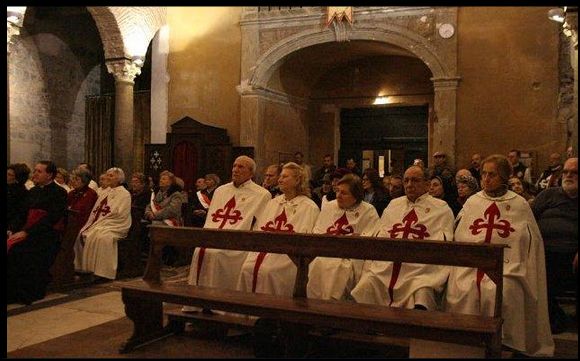
Cardinal Prefect celebrates Mass in Rome to commemorate 10th Anniversary


Dear Friends,

On the 22 of February 2011 we commemorated the 10th anniversary of the Pontifical Recognition of the Heralds of the Gospel given by late Pope John Paul II in 2001.

Cardinal Antonio Canizares, Prefect of the Congregation for the Divine Liturgy and the discipline of the Sacraments presided the Eucharist celebrated on this occasion at the Church of the Heralds of the Gospel, St Benedetto in Piscinula, Rome. In his homily the Cardinal encouraged all our members and friends to continue our mission of announcing Christ in our world with our characteristical enthusiasm.

I was very pleased to be there and I had the opportunity to pray for all of you in various significant places in Rome but in particular in the historical Coliseum where so many martyrs gave their lives to uphold the faith in Our Lord Jesus Christ, the same faith that, do to the heroism of those martyrs of the beginning of the Church, we have received today and will last till the end of times.

Sincerely yours,
In Jesus and Mary
Br Arthur EP


Photos: thanks to sanbenedettoinpiscinula.blogspot.com/

Tuesday, 1 March 2011

LIVING EXAMPLE OF THE GIFT OF WISDOM [Part 2]


Resume of the Doctoral Thesis in Theology of Msgr. Joao Scognamiglio Cla Dias, EP (cont'd)


Click here to read Part 1: http://heraldsgospelsinengland.blogspot.com/2011/03/living-example-of-gift-of-wisdom.html

It is easier to experience the gifts of the Holy Spirit than to explain them scientifically, as an emminent theologian affirmed. Monsignor Joao Cla overcame this problem by taking a unique approach to his doctorate in theology.

The Kingdom of God

The thesis begins with a theoretical discussion on grace and the gifts of the Holy Spirit, based on the episode of St. Luke’s Gospel in which Jesus answers the Pharisees regarding the coming of the Kingdom of God: “Being asked by the Pharisees when the kingdom of God was coming, He answered them, ‘The Kingdom of God is not coming with signs to be observed; nor will they say, “Lo, here it is!” or “There!” for behold, the Kingdom of God is in the midst of yoy.” (Lk 17:20-21)
In this simple dialogue there are two implicit contradictory conceptions of the Kingdom of God: the worldly one of the Pharisees, and the completely spiritual one of Jesus. There are in fact two forms of wisdom present here: that of the world and that of the Holy Spirit.

Innocence, the door to wisdom.

After presenting the doctrinal presuppositions on how grace and the gifts of the Holy Spirit operate in souls, as well as the speculative and practical effects of the gift of wisdom, the author proceeds to the biographical information, comparing the principal episodes of the life of Plinio Correa de Oliveira with the theological dovtrine on the gifts of wisdom and mysticism. The narration thus reveals, as in a compendium, the effects of the gift of wisdom in the soul of Dr. Plinio. Contrary to the experience of numerous mystics, who only reached the plenitude of these effects after a long journey of spiritual ascension, in Dr. Plinio, wisdom manifested itself in his earliest childhood, indicating that for him, the gate to wisdom was innocence.

Some contemplative effects of wisdom were especially evident in Dr. Plinio’s visualisation of history; in which, with great perspicacity, he discerned the “footsteps of God” For him, the centre of history was Our Lord Jesus Christ and His mystical spouse, the Holy Church, and the fight between good and evil was the true compass of events. From this basic principle he drew the doctrine exposed in his essay Revolution and Counter-Revolution. Another contemplative effect of wisdom was his school of thought, presenting a notion of the universe under two aspects, like two wings of the spirit: doctrinal and symbolic.. As Dr. Plinio was accustomed to recall, the divine perfections are reflected in the universe constituting a splendid mosaic, which the well-formed soul should know how to interpret and use as a means to raise itself to the Creator.

“Flash” -a movement of the gift of wisdom.

Among the most important elements of Dr. Plinio’s spirituality were the motions of the gift of wisdom, which he called “flashes” because of their similarity to a light that suddenly illuminates the understanding and inflames the will, disposing one to understand certain truths of the Faith, in a virtually evident and pleasing manner, and imparting a great generosity of soul to practice virtue. Reputable theologians verify the existence of this mystical phenomenon,confirming it to be the most sublime grace the soul can receive on this earth. According to Dr Plinio, these mystical graces are bestowed on all the faithful, more often than one might think, and various theologians share this viewpoint. Nevertheless an excessively rationalist formation leads many people to ignore the motions of the Holy Spirit, and the secularization of mentalities persuades them to give credence only to material values and the unbridled pleasures of life.

Ardent charity, discernment of spirits and prophetism.

Some practical effects of wisdom became manifest in Dr. Plinio as fruit of his ardent charity. Zeal for the glory of God acted as the driving force which constantly urged him to to give himself tirelessly to the works of the apostolate, spiritual formation of his followers and unceasing efforts for their perseverance in the vocation. This zeal for the salvation of souls led him to offer himself as a victim to God in 1975, seeking to obtain superabundant graces for the flourishing of the lay movement he founded. The sufferings resulting from a terrible car accident three days later -the after-effects of which prevented him from walking for the rest of his life -were the bloody price he joyfully paid with unbounded generosity.

The charism of discernment of spirits, which made him an unequalled director of souls, as well as the gift of prophetism, were some of the other practical effects of wisdom expressed in his person. His charism of prophetism remains registered in inumerable articles published in O Legionario, the official organ of the Archdiocese of Sao Paulo, and afterwards in other large-circulation periodicals in Brazil, such at the Folha de Sao Paulo.

Blessed are the peacemakers.

According to the common opinion of theologians, the gift of wisdom corresponds to the seventh beatitude: “Blessed are the peacemakers for they shall be called sons of God.” (Mt 5:9) Peace is the tranquillity of order, as St. Augustine teaches. Thus the wise man seeks to establish peace, first within himself, and afterwards around himself, creating conditions for true peace to reign. This was the ideal of Dr. Plinio’s entire existence: the restoration of Order, according to the Law of God, in temporal society. From this also arose this great complexity: not seeing the realisation of his most ardent desire, namely the fulfilment of the promise made by Our Lady in Fatima: “In the end, my Immaculate Heart will triumph.” This would be tantamount to the establishment of the spiritual kingdom of Christ on earth.

Love of the cross and configuration with Christ.

Those who open their soul to wisdom embrace suffering, Dr. Plinio stated. It is through suffering that the Christian becomes more like Christ, and this similarity is the principal and most sublime effect of the gift of wisdom. For the hedonist mentality of modern man, it is difficult to accept this truth, and accept suffering with resignation. This led Dr. Plinio to bring to his followers’ attention the importance of the cross in the process of sanctification: “We must never flee from suffering, as from a ghost, but rather pass through a series of archways of suffering throughout the course of life. They will lead us to the magnificent stained-glass window of death which opens … and then we will see heaven.” This disposition of soul led him to say at the end of his life: “I would die disappointed if I thought I had fled from even one ounce of suffering.”

This conviction in the face of adversity expressed itself above all in Christian resignation with which he confronted his final sickness. Although he had a presentiment of his impending end some months beforehand, even declaring it to some of his collaborators, he did not alter his routine of intense activity, nor did he manifest the symptoms of the disease which sapped his strength, but rather, he continued to march forward with confidence in
Providence towards “that magnificent stained-glass window of death”, certain of seeing heaven after passing through it. All the physical sufferings and interior trials of his final days were endured with a serenity, meekness and dignity that profoundly impressed all who accompanied him in the hospial until the final moment of departure for eternity. Shortly after breathing his last, his physiognomy, until then etched with pain, shone with abgentle smile, revealing a remarkable expression of peace, and confirming the authenticity of what he himself had taught and practiced: “It is a characteristic of oblation that it be made with such goodwill that, at the moment of the consummatum est a smile blossoms.”

His complete conformity with Our Lord Jesus Christ was consummated -the most sublime effect of the gift of wisdom.

[1] Benedict XVI, Speech, 5/12/08

Click here to read Part 1: http://heraldsgospelsinengland.blogspot.com/2011/03/living-example-of-gift-of-wisdom.html

LIVING EXAMPLE OF THE GIFT OF WISDOM [Part 1]


Resume of the Doctoral Thesis in Theology of Msgr. Joao Scognamiglio Cla Dias, EP

To read Part 2 click here: http://heraldsgospelsinengland.blogspot.com/2011/03/living-example-of-gift-of-wisdom-part-2.html

It is easier to experience the gifts of the Holy Spirit than to explain them scientifically, as an emminent theologian affirmed. Monsignor Joao Cla overcame this problem by taking a unique approach to his doctorate in theology.

In his thesis The Gift of Wisdom in the Spirit; Life and Work of Plinio Correa de Oliveira, Msgr. Joao Cla Dias, EP, decided to approach the theme from a unique perspective, by examining the power that the gift of wisdom acquires in one who profoundly lives it, rather than presenting its strictly abstract aspects. Thus the thesis focuses on analysing the action of the Holy Spirit in one of the greatest Catholic leaders of recent time: Plinio Correa de Oliveira, “an important figure in the history of the Brazilian Church,” according to a member of the examination board, Fr. Marcelo Neves.

Maintaining an objective perspective - as members of the examination board affirmed - Msgr. Joao gives his personal testimony regarding the gift of wisdom in Plinio Correa de Oliveira, which forty years of close contact allowed him to observe in detail. “No one could have explained this secret od Dr. Plinio Correa de Oliveira’s life and work with such insight as Msgr. Joao, his son and disciple” attested another examiner Fr. Alberto Ramirez.

Fr Carlos Arboleda highlighted an additional point: the thesis “aims at showing that salvation history is not isolated from human history , that the faith experience does not exclude an existence that interprets and acts upon it.” Consequently, to be more efficacious , theological teaching should provide living examples, making stated truths more tangible.

The need to live out the Faith.

Msgr. Joao Cla portrays and writes with balance and love, and “does the work of a theologian and not merely a narrator,” as Fr. Marcelo Neves notes.

Indeed, while the thesis is strongly biographical in character, it remains within the ambit of authentic theology. In order to produce a masterly and appealing theological work which not only instructs but also inspires the practice of virtue, it is necessary for the author to have lived the truths examined. Either the Faith is lived, or, as St James teaches, it is dead. (cf. Jms 2:14-26)
This important aspect of theological study was noted, in other terms by Pope Benedict XVI in a speech to the members of the International Theological Commission: “From the viewpoint of one who does theology, the fundamental virtue of the theologian is to seek obedience to faith, the faith that opens our eyes. This humility renders the theologian a collaborator of the truth. In this way it will not happen that he speaks of himself. Interiorly purified by obedience to the truth, he will reach, instead, the point that the Truth itself, that the Lord, can speak through the theologian and theology." [1]

The power of St Anthony’s testimony: “I saw Him!”

From the outset, in presenting his thesis defence, Msgr. Joao makes a point of demonstrating that the efficacy of personal testimony is superior to theological arguments alone. In this regard, he recalls how important for the faithful of Alexandria was the example of St Anthony in proclaiming the divinity of Christ, in the fight against the arians. “St Anthony - his thesis states - had mystically seen the divinity of Our Lord. He was a live witness to this truth of Faith. For this reason, he was sought by St Athanasius to come to Alexandria, where countless Christians and heretics gathered in the Basilica to see him. The nonagenarian hermit, whose mere presence imposed respect, sat near the altar while the Archbishop ascended the pulpit and proclaimed the divinity of Our Lord. Suddenly, a voice of protest arose from amidst the crowd. St Anthony was astonished by the unseemly interruption and asked for a translation of the words he had heard, since he did not understand Greek. ‘The Lord - they translated for him - was only a man, created by God and subjected to death and transition.’ St Anthony arose and exclaimed: “I saw Him!” A murmur ran through the naves of the church. On their knees, the faithful cried out: ‘He saw Him! He saw the divinity of Our Lord!, The authoritative voice of this man, for whom the supernatural truth of Christ’s divine nature had become, in effect, evident by virtue of a supernatural vision, was the greatest blow the heresy suffered, more than the splendid and logical doctrine exposed in the Council. This is an example of the value and contribution of a living witness.

Origin of the thesis, the testimony of the author: ‘I saw him!’

After this introduction, Msgr. Joao continues: “Now, mutatis mutandis, it must be declared that this thesis was also born of the author’s witness. “With profound emotion he recalls, in the first chapter of the thesis, the day -March 15, 2005- that he made his profession of Faith at the Altar of the Chair in St. Peter’s Basilica.

“As the pen moves across the paper in writing these lines, the left hand of the author rests once again on Sacred Scripture; and from the depths of his soul this declaration springs forth, with the same spirit, gravity and consciousness as in the previous oath”
The author solemnly declares that all transcriptions of Dr. Plinio’s words “are faithful to the reality of his expression during that time,” since they were taken directly “from the archive of his conferences, commentaries and conversations, in addition to his writings. If there be any disproportion in my appraisement of him, it would be for having fallen short of his true worth.”

Msgr. Joao goes on to consider the true joy he has had in knowing this treasure of oral and written works which rank among the doctrinal explanations produced by the Holy Church, based on Revelation, over the centuries. Nevertheless, he emphasises, having known “Plinio Correa de Oliveira intimately for forty years,” he was also the recipient of another “very noteworthy” blessing in seeing the “wealth and grandeur” of these doctrines “in a living manner, that is to say, “producing their effects in the soul of a man.”

Therefore, this thesis has been prepared not simply as a discourse of reason, but above all, as a testimony from the depth of the heart, declaring the importance of living example. For the supernatural truths regarding grace and the action of the Holy Spirit is souls -more specifically the gift of wisdom- became a virtually palpable reality for the author in his contact with Dr. Plinio, who was his teacher, leader, model and guide; his father and founder. He could well exclaim, “I saw Him!”

[1] Benedict XVI, Speech, 5/12/08

To read Part 2 click here: http://heraldsgospelsinengland.blogspot.com/2011/03/living-example-of-gift-of-wisdom-part-2.html