Totus Tuus - To Jesus through Mary.

To impel the beauty of the new evangelization – this is the charism of the Heralds of the Gospel; Its founder, Monsignor João Dias explains."The Heralds of the Gospel is a private association of faithful with a very special charism based essentially on three points: the Eucharist, Mary and the Pope."

The Heralds of the Gospel are an International Association of the Faithful of Pontifical Right, the first to be established by the Holy See in the third millennium, during a ceremony which occurred during the feast of the Chair of St. Peter (February 22) in 2001.

The Heralds of the Gospel strive to be instruments of holiness in the Church by encouraging close unity between faith and life, and working to evangelize particularly through art and culture. Their apostolate, which differs depending upon the environments in which they work, gives pride of place to parish animation, evangelizing families, providing catechetical and cultural formation to young people, and disseminating religious Iiterature.


Thursday, 6 December 2012

Feast of the Immaculate Conception - Saturday 8 December


Mary's Immaculate Conception

by Father William G. Most
In teaching that Mary was conceived immaculate, the Catholic Church teaches that from the very moment of her conception, the Blessed Virgin Mary was free from all stain of original sin. This simply means that from the beginning, she was in a state of grace, sharing in God's own life, and that she was free from the sinful inclinations which have beset human nature after the fall.

History of the Doctrine
There are two passages in Scripture which point us to this truth. We look first at Genesis 3.15, in which we see the parallel between Mary and Eve of which the early Church Fathers already spoke: "I will put enmity between you and the woman, and between your seed and her seed: he shall bruise your head, and you shall bruise his heel." The Jews saw this passage as referring to the struggle between Christ and Satan, and so the Church see in "the woman" a prophetic foreshadowing of the Virgin Mary (Vatican II, Lumen gentium, # 55).

If there is to be complete enmity between the woman and the serpent, then she never should have been in any way subject to him even briefly. This implies an Immaculate conception.
We can also reason from the text of Lk 1:28, in which the angel calls her "full of grace". If we can validate the translation--we can, and will do so, shortly--then in this verse we can see even more strongly the complete enmity with the serpent--for God's grace is complete opposed to Satan's reign. But if Mary was "full of grace," it seems that she must have been conceived immaculate.
We turn to the early Fathers of the Church. First, many, not all of them, make sweeping statements about her holiness. That could imply an Immaculate Conception. Secondly, very many of them speak of her as the New Eve. They could have reasoned: the first Eve had an immaculate start in life--no sin was yet committed. So the New Eve, who was to share in undoing the harm of original sin, should have also an immaculate start. However, none of the Fathers actually followed this line of reasoning. (A few Fathers even tried to find sins she had committed, e.g. St. John Chrysostom, Homilies on John 21. PG 59. 130ff).

During the middle ages, authors such as St. Bernard of Clairvaux and St. Thomas Aquinas denied the doctrine. At this time, the data from Scripture and the Fathers was still not clear. In addition, the understanding of original sin was not as clear as it should have been--it was often thought of as having a positive element, instead of merely being an original lack of the grace to which God calls us. This positive element was thought to be transmitted from parents to children through the marital act (which was itself thought to be somehow sinful, though pardoned by God), and so it was hard to see how there could be an immaculate conception. This conception had been found in some, though by no means all, of the Fathers. Now of course we know it to be false. Finally, it was not generally seen at this time how an Immaculate conception of Mary would not take away from the universality of redemption through Christ.

After a while, however, the theological tide began to turn, and the objections which had long obscured the content of divine revelation began to be overcome. This was due especially to the work of the Franciscan, Venerable John Duns Scotus. He showed that for God to preserve Mary from original sin was a greater redemption than to allow her to fall into it and then rescue her. Scotus wrote (cited from J. B. Carol, Mariology I, 368): "Either God was able to do this, and did not will to do it, or He willed to preserve her, and was unable to do so. If able to and yet unwilling to perform this for her, God was miserly towards her. And if He willed to do it but was unable to accomplish it, He was weak, for no one who is able to honor his mother would fail to do so."

We also note again that behind most of the objections was the rather positive notion of original sin. If we jump ahead several centuries to the clearer understanding of original sin we have now, we can remove this objection. Pope John Paul II epressed this understanding in a General Audience on Oct 1, 1986: "In context it is evident that original sin in Adam's descendants has not the character of personal guilt. It is the privation of sanctifying grace in a nature which, through the fall of the first parents, has been diverted from its supernatural end. It is a 'sin of nature' only analogically comparable to 'personal sin'". In other words: It is only the lack, or privation, of that which God wanted us to have, which we should have inherited from our first parents."
Now back to our history. After that this change in theological tide had gone far towards removing objections, the Popes began to make statements of varying clarity. Sixtus IV in 1477 (DS 1400) praised the liturgical celebration of the Immaculate Conception. The same Pope added further support in 1483 (DS 1425-26), condemning those who said it was sinful to preach and believe the Immaculate Conception. The Council of Trent explicitly declared in its decree on original sin (DS 1516): "... it is not its intention to include in this decree ... the blessed and Immaculate Virgin Mary, Mother of God. Rather, the Constitutions of Sixtus [IV] of happy memory are to be observed."

After Trent, the attacks on the Immaculate Conception were greatly moderated. Then Pope St. Pius V, in 1567 (DS 1973) condemned the error of Baius who said Our Lady was subject to original sin. And in 1568 the same Pope put the feast of the Immaculate Conception on the calendar of the Roman breviary. Alexander VII in 1661 explained the doctrine much as Pius IX did later: DB 1100. Pope Clement XI in 1708 made December 8 a holyday of obligation. Further, the Sixth Provincial Council of Baltimore in the U. S. in 1846 declared Mary Immaculate to be Patroness of the United States, and Pius IX on Feb. 7, 1847 confirmed this dedication.

The result was that about a century and a half before the definition of 1854, the whole Church believed the Immaculate Conception. Finally, in Ineffabilis Deus, in 1854, Pius IX defined this doctrine and added that Mary was conceived immaculate by anticipation of the merits of Christ. This is not strange, for to the eye of God, all time is present.
Now the Church continues to elucidate the scriptural basis of the doctrine of the Immaculate Conception. Pius XII, in Fulgens corona, 1953 wrote: "... the foundation of this doctrine is seen in the very Sacred Scripture itself, in which God ... after the wretched fall of Adam, addressed the ... serpent in these words... 'I will put enmity....' But if at any time, the Blessed Virgin Mary, defiled in her conception with the hereditary stain of sin, had been devoid of divine grace, then at least, even though for a very brief moment of time, there would not have been that eternal enmity between her and the serpent ... but instead there would have been a certain subjection."

Preventive redemption
We have said that Mary needed redemption, although she was never subject to original sin. Nor did she have an "obligation" to contract it, as some have foolishly said: there can be no obligation to any sin. We can merely say she would have been in original sin in the sense just explained, i.e. , she would have been born without grace, were it not for the preventive redemption. The word "preventive" means anticipatory: the grace she received at her conception was given in anticipation (Latinpraevenire) of Christ's merits, which earned that grace.

The nature of Mary's grace at the Immaculate Conception
In Lk 1:28 the archangel hails her as, "full of grace". Most versions today do not use that rendering, but greatly weaken it. Yet it is the correct translation as we can see from the Magisterium (Pius XII,Fulgens Corona, AAS 45, 579, and constant use of the Church) and also from philology.

For the Greek word in the Gospel is kecharitomene. It is a perfect passive participle of the verb charitoo. A perfect passive participle is very strong. In addition, charitoo belongs to a group of verbs ending in omicron omega. They have in common that they mean to put a person or thing into the state indicated by the root. Thus leukos means white, soleukoo means to make white. Then charitoo should mean to put intocharis. That word charis can mean either favor or grace. But if we translate by favor, we must keep firmly in mind that favor must not mean merely that God, as it were, sits there and smiles at someone, without giving anything. That would be Pelagian: salvation possible without grace. So for certain, God does give something, and that something is grace, are share in His own life. So charitoo means to put into grace. But then too, kecharitomene is used in place of the name "Mary". This is like our English usage in which we say, for example, someone is Mr. Tennis. That means he is the ultimate in tennis. So thenkecharitomene should mean "Miss Grace", the ultimate in grace. Hence we could reason that fullness of grace implies an Immaculate Conception.

Overflowing grace: Pius IX, in the document, Ineffabilis Deus, defining the Immaculate Conception in 1854 wrote: "He [God] attended her with such great love, more than all other creatures, that in her alone He took singular pleasure. Wherefore He so wonderfully filled her, more than all angelic spirits and all the Saints, with an abundance of all heavenly gifts taken from the treasury of the divinity, that she, always free from absolutely every stain of sin, and completely beautiful and perfect, presented such a fullness of innocence and holiness that none greater under God can be thought of, and no one but God can comprehend it."
What about the words of Jesus in Lk 11:27-28 (cf. Mt. 12:46-50 and Mk 3:35)? A woman in the crowd exclaimed: "Blessed is the womb that bore you...." He replied: "Rather blessed are they who hear the word of God and keep it."

The dignity of being Mother of God is a quasi infinite dignity, as we just saw from the words of Pius XI. Yet here, our Lord is teaching us that the holiness coming from hearing the word of God and keeping it is something greater still. Her holiness must indeed be great--so great that "none greater under God can be thought of, and no one but God can comprehend it."

Even though Mary was full of grace at the start of her life, yet she could still grow, for, as it were, her capacity for grace could increase.
In general, a soul will grow in proportion to these things: (1) The greater the dignity of the person, the greater the merit In her case, the dignity of Mother of God is the highest possible for a creature. (2) The greater the work, the greater the merit: her cooperation in the redemption was the greatest work possible to a creature. (3) The greater the love, the greater the merit. Love of God means the attachment of our will to His. Her will adhered supremely, with no obstacle at all, so that even ordinary household duties, which she saw as the will of the Father for her, were supremely valuable.

Excerpted and adapted from Theology 523: Our Lady in Doctrine and Devotion, by Father William G. Most.
Copyright (c) 1994 William G. Most.
This electronic text (c) Copyright EWTN 1996. All rights reserved.

Visit of Right Rev Alan Hopes, Auxiliary Bishop of Westminster.


Dear Friends
 
We were very pleased to receive the visit last Saturday, 1st December, of Right Rev Alan Hopes, Auxiliary Bishop of Westminster.
He came to have a private meeting with us and to pray Evening Prayer at our chapel.
It was very meaningful because liturgically it was the precise beginning of the Advent of the Lord.
Before we started to pray we put all of you in our intentions.
He is a very nice and charming person as you can see it in the photos. We all enjoyed his visit very much.
God bless
Deacon Arthur, EP
Heralds of the Gospel


Sunday, 25 November 2012

Faith Matters Autumn 2012 Lecture 1 Archbishop Vincent Nichols


http://vimeo.com/52605983

Feast of Christ The King.


This Sunday is the Feast of Christ the King, and the end of the liturgical year. It is a good time to meditate the greatness of Christ, his Lordship over all creation, the shortness of time and the great joy of spending all eternity with him.  Below is an essay on Christ's Kingship by Fr. Hans Urs von Balthasar. More information may be found at:
http://www.ignatiusinsight.com/features2010/hubalthasar_christtheking_nov2010.asp 

The King and His Kingdom | Fr. Hans Urs von Balthasar | From You Crown the Year with Your Goodness: Sermons Throughout the Liturgical Year | Ignatius Insight

"Pilate said to Jesus, 'Are you the King of the Jews?' Jesus answered, 'Do you say this of your own accord, or did others say it to you about me?' Pilate answered: 'Am I a Jew? Your own nation and the chief priests have handed you over to me; what have you done?' " (Jn. 18:33-35).

A strange, inconclusive dialogue. Questions are met with counterquestions. The governor's question can only be asked from within the perspective of Roman politics and administration. Jesus could have answered with a straight "No": he raised no claim to authority in this area. But how could Pilate have arrived at such a question in the first place unless there were, in the background, a third factor, God's chosen people, for whom the phrase "King of the Jews" had an entirely different religious and messianic import? "Did others say it to you about me?" Is there something of their view, their problems and their questions in your question to me? For if both of you, Jew and gentile, together ask this question, it acquires a new and far greater scope. Then the whole world is asking who I am and what is my authority.

Pilate gives a strange answer. Indirectly he admits that he is not asking of his own accord: "Your own nation and the chief priests have handed you over to me", evidently on account of the word king, which has a messianic ring as far as Jews are concerned and is meant to sound political to the gentiles. But Pilate says, "Am I a Jew?" He rejects any kind of solidarity with the Jews. He is not interested in the associations the word king has for them. He is Rome's representative. Thus he falls into the trap laid by the Jews and operates on the basis of the secular-political implications of Jesus' kingship. And after all, was that not what interested the Jews too? Anti-Roman politics? Israel's liberation struggle? What else did they want from the promised Messiah? And why had they handed Jesus over to the Roman governor? Because Jesus' whole approach was not secular, not political, not messianic enough for them. The people had long wanted to proclaim him king when he distributed bread to the multitude. Only a few days earlier, at his entry into Jerusalem, the people had greeted him with hosannas. But to the leaders' of the nation he was a maverick idealist, merely an obstacle to their realistic political goals; he came bringing ethical demands that were of no use, for he put forward no political theology of any kind. What good to them were his miracles of healing, which placed him in the line of the old prophets? Basically they needed no prophets now, only resolute, ambitious men of orthopraxy. Of course, Jesus had deeds to his credit, but as far as Israel's pundits were concerned, they were not the right ones. On the basis of his deeds they insinuated to Pilate that he was a troublemaker, stirring up the people. "What have you done?" Pilate asked him.
Jesus answered, "My kingship is not of this world; if my kingship were of this world, my servants would fight, that I might not be handed over to the Jews; but my kingship is not from the world." Pilate said to him, "So you are a king?" Jesus answered, "You say that I am a king. For this I was born, and for this I have come into the world, to bear witness to the truth. Everyone who is of the truth hears my voice."
When asked, "What have you done?" Jesus replies, "My kingship is not of this world. " He leaves much unsaid. He does not say that he has done nothing, nothing in this world. For he came into this world for the express purpose of doing something, something in it. His deeds are performed in this world. And they are intended for this world. The world is to see and apprehend the testimony he gives in it. We need to realize the whole tension that lies between, on the one hand, the words "not of this world" and, on the other hand, the expression "for this I was born, and for this I have come into the world" . He is not someone who happens to find himself in the world and, oppressed by its narrow confines, strives to extricate himself from it. He is not someone who flees the world. He is not a Buddhist. For him, the world is not the starting point of his yearning transcendence toward some higher life; on the contrary: "For this I have come into the world." The world is the destination of a movement, a journey. He comes from outside and from above in order to show the world something, in order to proclaim something of which it is unaware, something that is not simply a confirmation of its longing for escape. He came because he had something to do on this earth, something the Jews would gladly have exploited for political ends, something Pilate is at pains to understand and evaluate in political terms, but something that, as Jesus says, "is not of this world".

He illustrates this by referring to the fact that his servants did not fight to prevent his being arrested by the Jews. In fact his arrest did include a pusillanimous scene of political theology, namely, Peter's sword stroke, which ridiculously managed only to shear off an ear and was immediately disavowed by Jesus. For this political theology on Peter's part put him willy-nilly in solidarity with the pseudoreligious views of those Jews who wanted no other Messiah but a political one.

No. "My kingship is not of this world." And yet, Jesus has come to this world. He came to his Father's kingdom, the kingdom of God, whose King he is. He says this just once, here, as he appears before the court and faces death. His enthronement as King will be complete on the Cross, when the famous inscription is placed over his head in the three languages of the world of that time. So that everyone will understand. And now the assertion is categorical: "King of the Jews", not—as the Jews would have liked—"he called himself the King of the Jews". No. Truly King of the Jews. "For this I have come into the world, to bear witness to the truth." Thus, royally, he bears witness.

How strangely he speaks. What has this being a king to do with bearing witness to the truth? The two are identical. And they coincide with the assertion that "my kingship is not of this world". Why? Because the truth is that "God so loved the world that he gave his only-begotten Son", finally and decisively, on the Cross, when he took the world's guilt upon himself and, as the Lamb, the scapegoat, bore it away. It is in carrying this guilt that he bears witness to the truth. The truth of divine love. It is the only credible testimony to this love. The world is an ocean of suffering and injustice—how can God say that he loves it?! The whole idea is laughable! But on the Cross there is no laughing; God shows that he and his love are serious: he hands over his Son. And the Son shows that he and his testimony are serious: he cries out as he undergoes that forsakenness by God that belongs to sinners. This is the most extreme, most high-profile solution imaginable, and God has carried it through. That is why, on the Cross, the world that is opposed to God and mocks God is vanquished. "Be of good cheer, I have overcome the world." And so he says, "Yes, I am a King." Not a king within the vanquished world but a King who sits on a throne exalted high above it. Exalted by the Cross. And naturally the vanquished world belongs to this kingdom, although the kingdom is not of this world.

Jesus does not permit the world he has conquered for God on the Cross to continue to exist as it was. He implants God's rule in it. In men's hearts. Divine love has become "at home" on the earth through him. In the hearts of the poor, of children, of the merciful, the gentle, the persecuted, in pure hearts. In canonized saints and many other saints. They do exist. Together they constitute a kingdom, and now and then we actually see or feel some small piece of this kingdom. Everyone knows that they are not interested in world conquest; they cannot even organize themselves to form a significant power in the world's terms. They have no plan to change the world so that, in subsequent generations, the greatest possible number of people may experience the greatest possible happiness. Their plan concerns the present: now, today, here, in the immediate surroundings, something of the love of God is to become reality. Some suffering is to be soothed, something of the bliss of self-giving is to be experienced. For God's love is selfless, and it can only take effect in the world when the world has accepted something of the spirit of selflessness, of giving for no reward.

One might think that this message from God comes from so far away and from such a height that man is incapable of grasping it. Christianity seems to be a teaching that is not for this world. Not realistic enough. But Jesus ends with these words: "For this I have come into the world, to bear witness to the truth. Everyone who is of the truth hears my voice." Everyone. Not only the person who has studied theology, not even the person who has learned his catechism or has merely listened to a sermon. Everyone. This King has a way of making himself understood to everyone. Perhaps it is that, on the basis of the Cross, every human suffering has acquired a new hue, a special quality that comes from the Cross and lends wings to his voice. It is true, however, that only those who are of the truth will hear it. Anyone who, somehow or other, perhaps unconsciously, bears within him something of the mystery of divine love knows that ultimately only loving can give a meaning to existence. Everyone can hear this voice. Christians have no monopoly here; they only have a special task, namely, to carry out into the world, quite explicitly and deliberately, the testimony they have heard and experienced in their own lives. They need not be surprised to find, in many places in this world, already existing traces of the truth they are openly proclaiming. Often these traces are so clear that they put Christians to shame. For the world in its totality already belongs to the kingdom of God, which is not part of this world. The passing world in which we live is part of that vaster, abiding kingdom in which God lives, who is all in all.


You Crown the Year with Your Goodness: Sermons Throughout the Liturgical Year

by Hans Urs von Balthasar


You Crown the Year with Your Goodness is a remarkable work, containing timely and timeless homilies for the liturgical year by a profound spiritual writer.

Originally broadcast on the radio, the homilies in this volume span decades and represent some of the best of Father Hans Urs von Balthasar's preaching. They are arranged to correspond with the Church's liturgical calendar, and include homilies on major feast days of Christ, his Mother, and the liturgical seasons. Each homily makes for insightful, informative, and inspirational spiritual reading, deepening the reader's appreciation for the Word of God and helping him to enter into the great Mystery of God.

Also included are Father von Balthasar's Year's End Examination of Conscience and four talks on Jesus Christ, that address contemporary debates about the Lord. This work is a feast for the heart and the mind presented by a man described by Pope Benedict as "a priest who, in obedience and in a hidden life, never sought personal approval, but rather in a true Ignatian spirit always desired the greater glory of God".


Hans Urs von Balthasar (1905-88) was a Swiss theologian, considered to one of the most important Catholic intellectuals and writers of the twentieth century. Incredibly prolific and diverse, he wrote over one hundred books and hundreds of articles. Read more about his life and work in the Author's Pages section of IgnatiusInsight.com.


Wednesday, 21 November 2012

Blessing and inauguration of a new Chapel of the Heralds of the Gospel


Dear Friends
I am pleased to send you some photographs of the blessing and inauguration of the new Chapel of the Heralds of the Gospel at our formation house in Toledo, Spain.

This took place last Monday at 7pm. Brother Michael and myself we were pleased to participate in this event.

The Solemn Mass was celebrated by His Excellency Braulio Rodrigues Plaza Archbishop of Toledo and Primate of Spain.The Vicar General and the Dean of the Cathedral were among the 22 priest concelebrating the Mass. The choir enhanced the celebration.

Next time you are in Madrid do not miss to visit this house which is also yours.

God bless
Deacon Arthur
Heralds of the Gospel


Tuesday, 6 November 2012

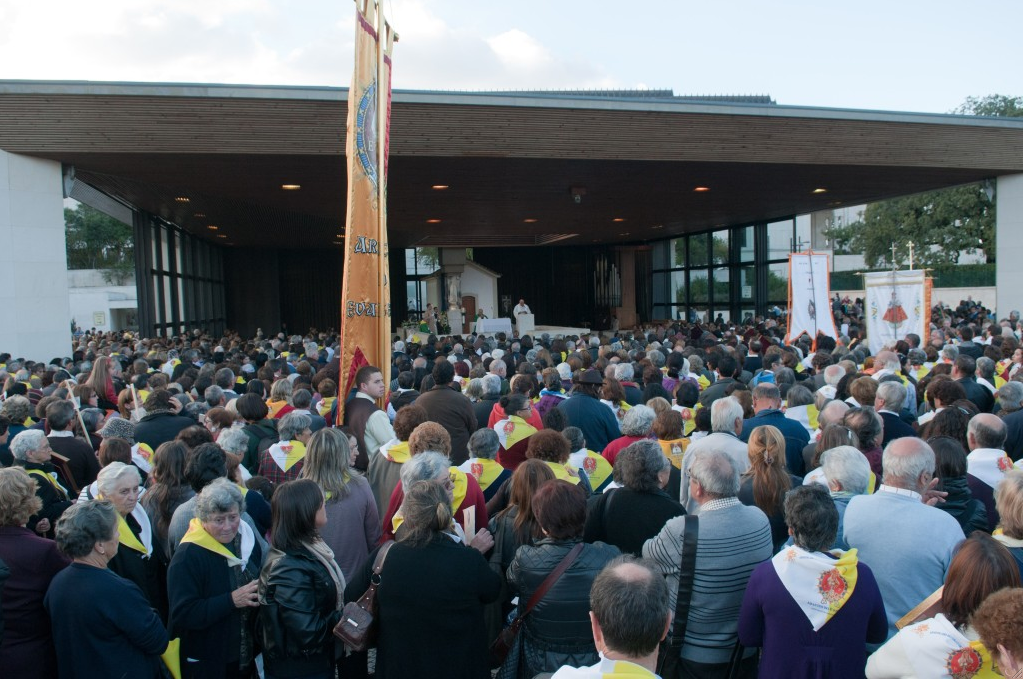
Annual Gathering in Fatima organized by the Heralds of the Gospel

Dear Friends
 
I am pleased to send you some photos taken by Br Michael at the Annual Gathering in Fatima organized by the Heralds of the Gospel from Portugal. This year almost 12000 faithful got together for Rosary Procession at the place of the apparitions, and Mass celebrated by the Auxiliary Bishop of Lisbon, Right Rev. Joaquim Mendes, and concelebrated by eighteen priests.
 
They were very blessed to hear a message from Pope Benedict XVI sent specially for this event, which said:
 
His Holiness Pope Benedict XVI sends a cordial greeting to all the participants of the National Meeting of the members of the Apostleship of the Heralds of the Gospel, and encourage them to grow in the awareness that Christians, by the grace of God, 'become temples of the Holy Spirit, living stones to built the Church', so they can rekindle the commitment to pass on to others this news of salvation, because the ' love of Christ which fills our hearts calls us to evangelize'".
 
Br Michael prayed for all of us there.
God bless
Deacon Arthur
Heralds of the Gospel